Before we begin, this is a long one, so stick the kettle on, grab a cuppa, and settle in.
Some places impress you, and then there are places that make you question your life choices.
The Scottish Highlands did both.
I expected this trip to be good. I expected wildlife, good company, dramatic scenery and, with a bit of luck, a few photographs I would be pleased to bring home.
What I did not expect was for four days in the far north of Britain to leave me questioning why on earth any of us choose to spend so much of our lives surrounded by concrete, traffic, full inboxes and a false sense of urgency.
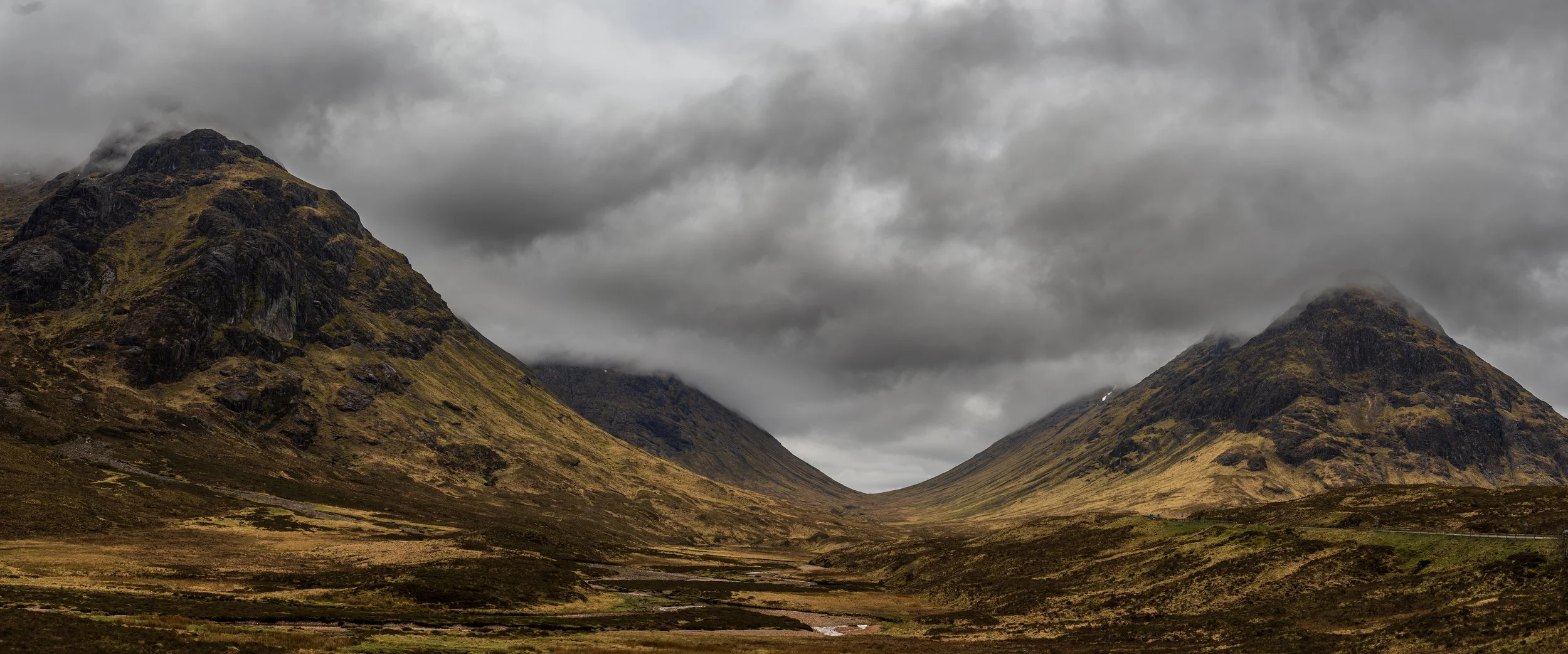
Because once you have stood in a place where the mountains swallow roads whole, where the lochs stretch out deep black and silent, and where stepping outside each morning feels like opening the first page of an adventure book, “normal life” starts to look fairly mundane.
Day One
Heading North
My day started at 4am with the slightly ridiculous realisation that flying to Scotland was somehow cheaper than parking at the airport.
The return flight to Glasgow had cost me just £35.
Airport parking had cost £85.
To this day, I still can't quite get my head around the fact that I can climb aboard a flying metal tube, travel at roughly 500 miles per hour across the country, and arrive somewhere completely different for less money than it costs to leave my car on an eight-foot square patch of tarmac for a few days.
The maths simply doesn't work in my head.
Anyway, if you are familiar with airports, you know the drill: park the car, get to the terminal, panic through security even though you've done nothing wrong, put all your items of clothing back on, and go find an alcoholic beverage no matter what time of the morning it is.
For as long as I can remember, a Wetherspoons breakfast and a pint have been my pre-flight tradition. There’s no deep meaning behind; I just can, so I do! With breakfast and a pint demolished, headphones in, and an overpriced coffee close to hand, there was nothing left to do but wait for the departure board and enjoy one of the great free forms of entertainment available at any airport: people watching. You never know what visual treats you'll witness.
I should probably explain why I was at the airport. If you haven’t guessed already, I was making my way to the Scottish Highlands. Why I was going, though, is the important part.
A few months earlier, I’d received a phone call from Mike Phelps, who was looking to test a new location for an Apex Adventures mini-break based around Loch Shiel. I’ll explain what Apex Adventures is in more detail later in the blog. The opportunity sounded incredible, but initially I wasn’t sure if I could make it work. Like most people, I found myself weighing up costs, commitments, and all the practical reasons not to go.
This thought process seemed very sensible and very boring. Life is too short.
Opportunities like this don’t come along every day, and I felt genuinely honoured to be invited. More importantly, it was a chance to push myself outside my comfort zone, something I’ve been trying to do more of in recent months. Albeit photography-related, so in reality I was still very much within my comfort zone.
The goal of the trip was simple enough: travel into the Scottish Highlands for the very first time, photograph White-tailed Eagles, and help Mike and the rest of the gang test out the location and accommodation.
Even writing that now feels slightly surreal. I’ve just typed it out as though it's a completely normal thing to do.
For most of my audience reading this blog, it probably is.
For those of you who are a bit more normal and aren’t completely obsessed with wildlife photography, White-tailed Eagles are the largest birds of prey in the UK, with wingspans reaching well over two metres, there stronghold thanks to conservation efforts is the Scottish Highlands. They’re also a species I’d dreamed of seeing and photographing for many years.
As I sat waiting for the flight, the anticipation had started to hit me, and it hit me hard.
Full-on childhood levels of excitement.
Before arriving, I had deliberately kept my expectations fairly open. I'd seen photographs and videos from places in and around the Highlands and knew Scotland would be beautiful. I knew the wildlife had the potential to be spectacular if we were lucky enough to find it. Beyond that, though, I wanted to experience everything with fresh eyes.
Looking back now, that was probably the best decision I could have made.
Nothing could have prepared me for what was waiting beyond Glasgow Airport.
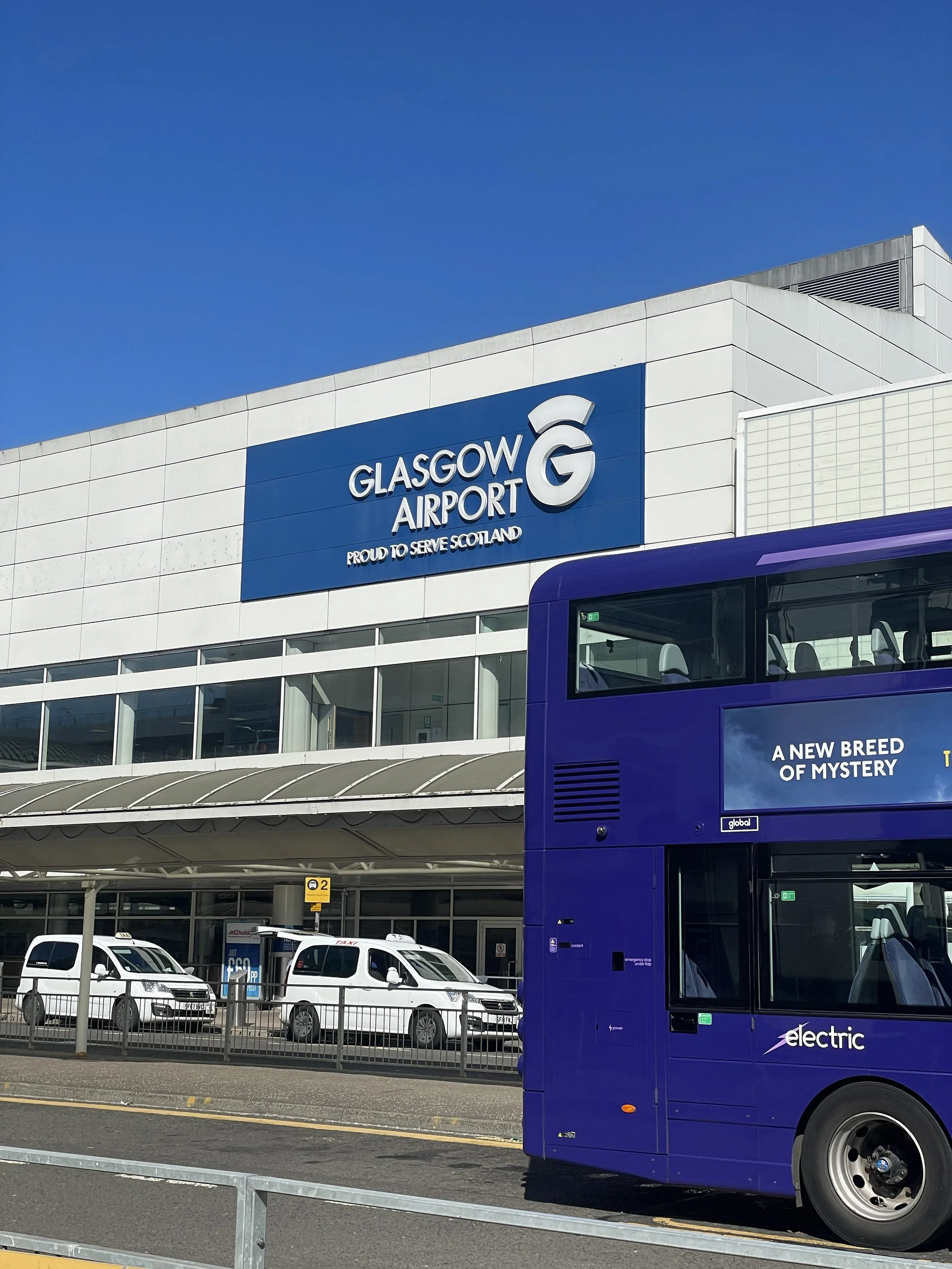
This isn’t photoshop the sky really was that blue in Glasgow
Meeting My Chauffeur
After a short flight, I found myself standing outside Glasgow Airport, where the next stage of the adventure was about to begin.
Now, every proper adventure needs a chauffeur, right?
Mine arrived in the form of Aaron Chandler.
"Hello, Sausage!"
A greeting that probably sounds very strange to anyone reading this blog for the first time.
Aaron and I first met at RSPB Bempton Cliffs, a trip I wrote about in a previous blog. Since then, we've become good friends through our shared love of wildlife photography, bad jokes, and the occasional questionable life decision involving alarm clocks and camera equipment.
The "Sausage" nickname dates back to a project I started earlier this year called We Are Wildlife Photographers. During the first phase of the project, a group chat was created for everyone involved. Within about five minutes, any hope of professionalism had disappeared entirely. Nicknames were assigned, banter became the group's primary language, and somehow both Aaron and I ended up being known as Sausage.
Why?
I genuinely have no idea.
At this point, I've stopped asking questions.
Aaron is also known as "The Uncommitted Photographer"—a title that is entirely tongue-in-cheek because he is probably one of the most committed photographers I know. He is currently working hard to turn his photography passion into a full-time career, and having seen both his work ethic and his images, I genuinely wish him every success.
After loading my bags into the car and exchanging the usual greetings, we pointed ourselves north and began the drive towards Fort William.
At the time, I thought the White-tailed Eagles would be the highlight of the trip.
I had absolutely no idea that the drive itself was about to become one of the most memorable parts of the entire weekend.
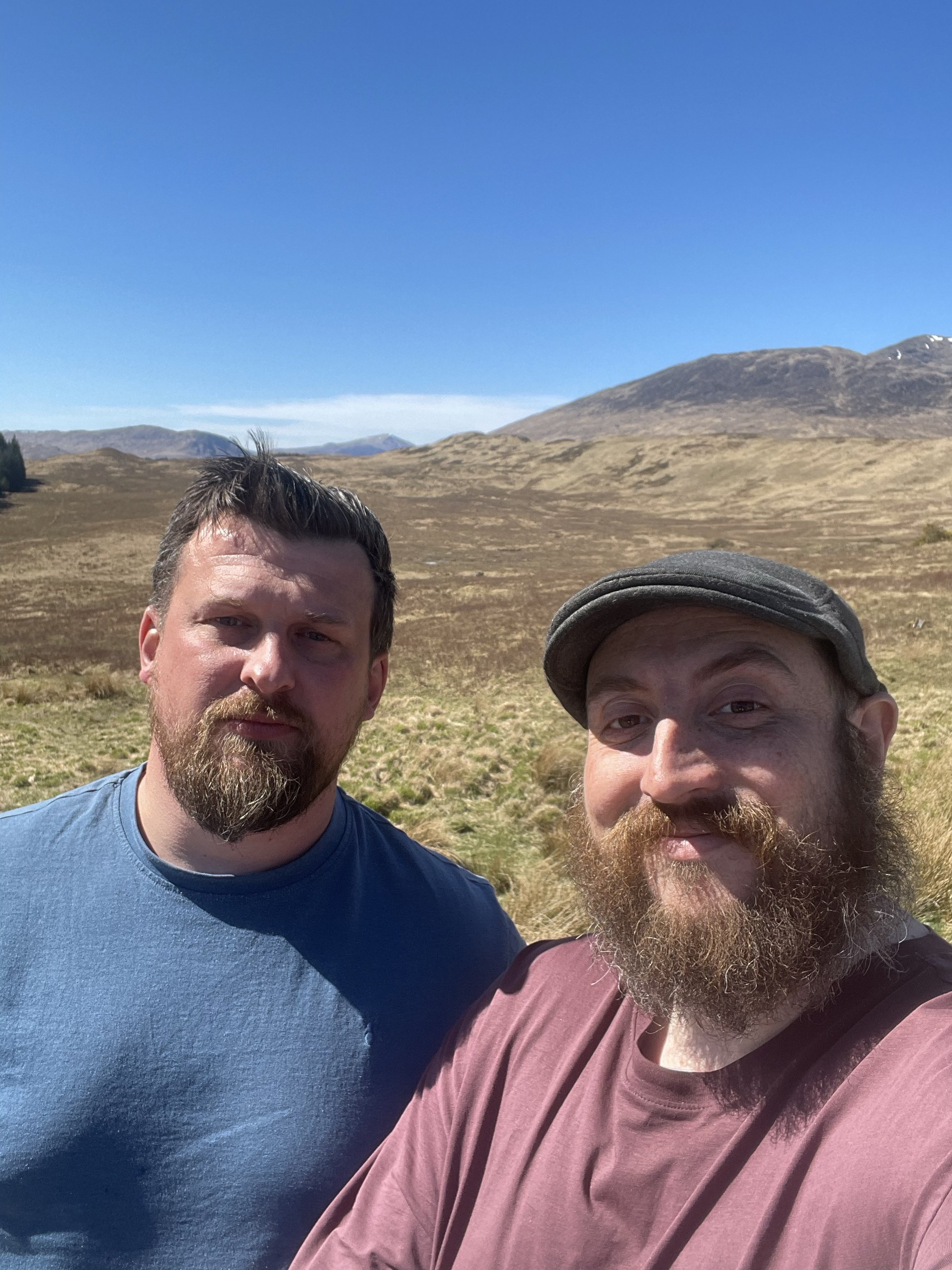
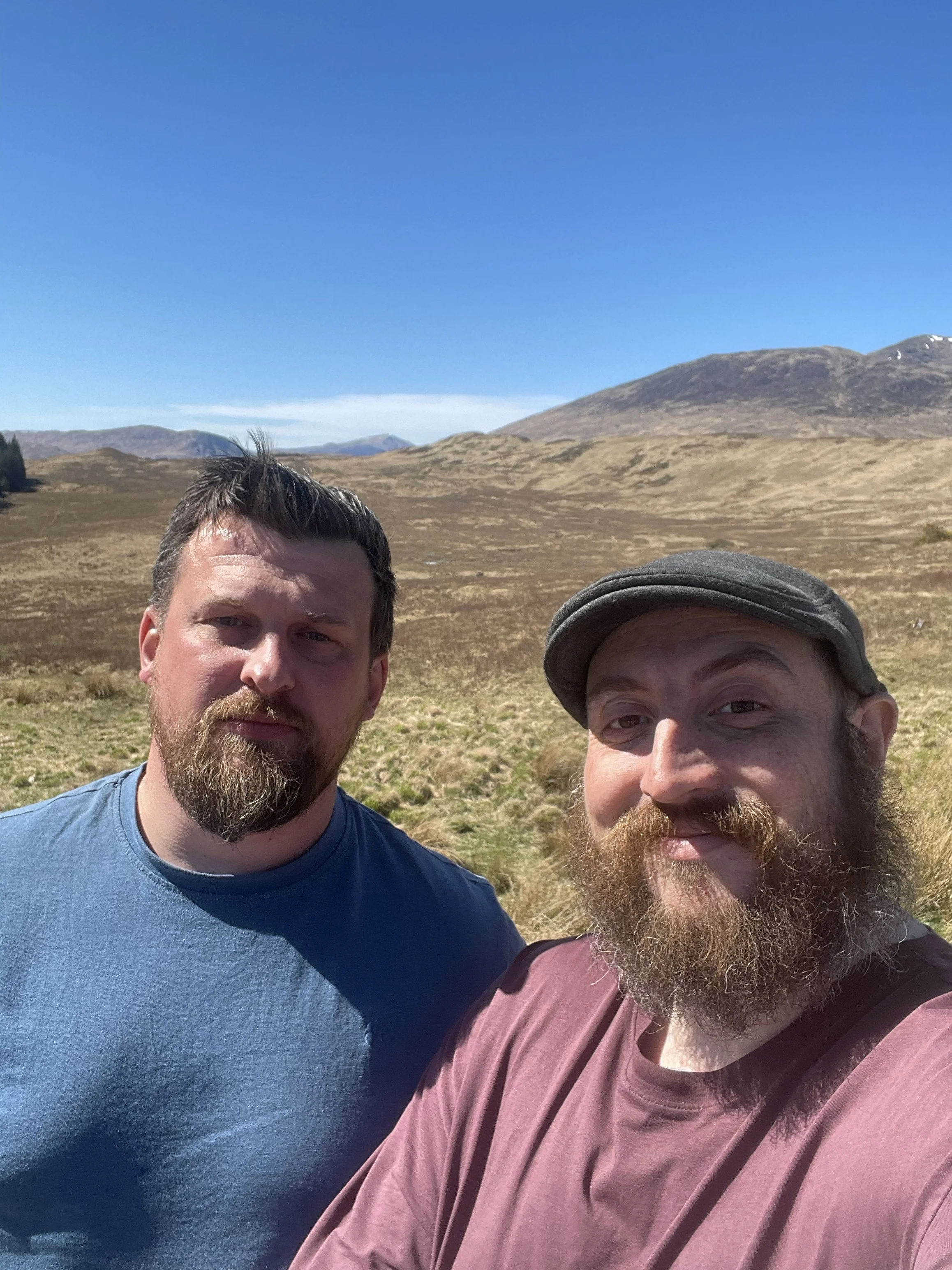
ME and Aaron in the highlands
Go check out Aarons photography here - https://www.instagram.com/theuncommittedphotographer/
The Drive
Within an hour of leaving Glasgow, I realised I had made a serious mistake.
I should have visited the Scottish Highlands years ago.
The original plan was: drive north to Fort William, photograph some incredible wildlife, have a laugh with friends, and see what happened. What I hadn't accounted for was becoming completely distracted by the journey itself.
It doesn't take long to leave the city behind. One moment you're navigating roundabouts and traffic lights, and the next you're surrounded by landscapes that make you question why you've spent so much of your life indoors.
The mountains were impressive, of course, but what really captured my attention were the lochs.
I'd seen large lakes before, but this felt different. As we followed the shores of Loch Lomond and continued deeper into the Highlands, the water seemed endless. Around every corner was another bay, another inlet, another stretch of water disappearing into the distance. There is something mysterious about a loch that I can't quite explain. You can usually see the top of a mountain, and if you're determined enough, you can climb it. A loch feels different. Darker. Older. Full of secrets.
I can completely understand why Scotland has so many myths, legends, and folklore linked to its waters.
As beautiful as the scenery was, most people would probably spend the drive admiring the mountains and discussing the history of the Highlands.
We did something much more important.
We ranked bridges 🤣
Now, before you judge us too harshly, this wasn't some casual observation. This was a highly scientific and completely objective ranking system developed over several hours of careful consideration.
Each bridge was scored on a number of critical criteria:
Aesthetic appearance
Construction materials
Integration with the surrounding landscape
General bridge-ness
Most importantly, the quality of the view from the bridge itself
As the miles rolled by, scores were awarded, rankings adjusted, and heated debates took place. Certain bridges immediately established themselves as strong contenders. Others were frankly embarrassing and should probably consider being less bridge-like in future.
A solid 9 out of 10 bridge, even if I do say so myself!
I wish I could tell you the bridge rankings improved our understanding of Scottish infrastructure but they didn't.
However, they did make us laugh for a large portion of the journey.
As we ventured further north, the landscape became almost impossible to describe. Every few miles we found ourselves saying the same thing.
"Look at that." Then five minutes later:
"No, seriously, look at that."
The Highlands simply don't stop.
The scenery doesn't gradually build towards something spectacular. It just keeps delivering one incredible view after another. Just when you think you've found the highlight, another mountain appears, another loch opens up beside the road, or another valley stretches away into the distance.
Then came Buachaille Etive Mòr and Glencoe.
People speak about Glencoe with a certain reverence, and having now stood there myself, I completely understand why.
It doesn't feel like a normal landscape. It feels ancient.
The dramatic peaks and vast valleys that exist today were shaped by glaciers during the last Ice Age, carving out the scenery that draws millions of visitors every year. Long before that, the area was part of an ancient volcanic landscape, helping create the rugged terrain that makes Glencoe so distinctive today.
Standing there, surrounded by mountains that seemed to rise endlessly from the valley floor, I felt incredibly small.
You can see a thousand images online, watch every YouTube video available, and still not fully understand what the Highlands feel like until you're standing in the middle of them yourself.
The perfect example came when a military plane suddenly thundered through the valley.
Normally, seeing a large plane at low level would dominate your attention.
Instead, it looked tiny.
Like a gnat flying through the landscape, a landscape so vast that even a military aircraft appeared insignificant.
Naturally, the cameras came out almost immediately. The light wasn't ideal. In fact, it was probably the harshest light a landscape photographer could ask for. Scotland had apparently decided to put on wall-to-wall sunshine, a meteorological event so rare that every local we spoke to felt obliged to remind us how lucky we were.
Under normal circumstances, I'd have complained.
But when you're standing in Glencoe for the first time, surrounded by scenery like that, you don't sit in the car waiting for better light.
You get out and take the photograph.
Looking back now, this was the moment the trip truly began.
Not when the alarm went off at 4am.
Not when the plane landed in Glasgow.
Not even when I met Aaron.
This was the point where the Highlands got their hooks into me.
And they never really let go.
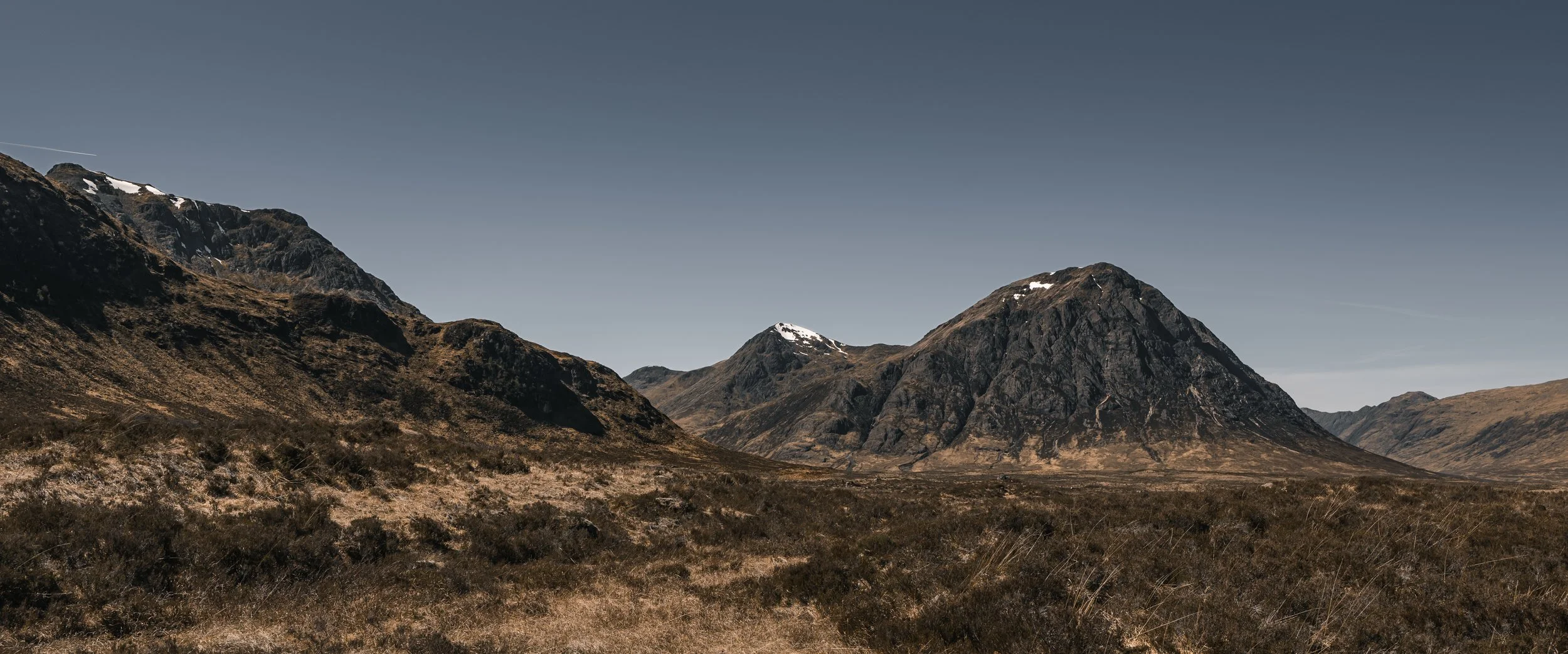
A 4 shot panorama of Buachaille Etive Mòr with snow still visible in May 2026
Fort William Was Calling
As incredible as Buachaille Etive Mòr, the Three Sisters, and Glencoe had been, eventually it was time to continue north towards Fort William.
To say I was impressed by what I'd seen so far would be a massive understatement. The landscapes had been genuinely mind-bending, the sort of places that make you stop talking for a moment and simply take it all in. I was completely awestruck.
That said, I couldn't help feeling that I wasn't doing them justice photographically. We had been blessed with wall-to-wall sunshine, which was fantastic for exploring, but less ideal for the dramatic landscape images I had imagined before the trip. For me, places like Glencoe almost demand a bit of atmosphere—moody skies, low cloud clinging to the mountains, maybe even a touch of rain sweeping through the valleys. The conditions were beautiful, but the photographer in me couldn't help wanting just a little more drama.
After spending around an hour admiring the scenery and taking far too many photographs, we jumped back in the car and continued towards Fort William.
Not long into the drive, another icon of the Scottish Highlands came into view.
Ben Nevis.
At 1,345 metres (4,413 feet), Ben Nevis is the highest mountain in the United Kingdom and attracts well over 100,000 walkers every year. Despite its popularity, standing beneath it for the first time was a surprisingly humbling experience.
It was dominate in the landscape. Everywhere you looked, Ben Nevis seemed to be watching over the surrounding area, its vast bulk rising above Fort William and the neighbouring glens.
For someone visiting this part of the country for the first time, it was impossible not to stop and stare.
Before heading to our accommodation, we decided to make the most of the extra time. The car needed charging, we needed lunch, and Fort William seemed as good a place as any to stretch our legs after several hours on the road.
So we grabbed some food, wandered around town for a while, and enjoyed the chance to soak up a little more Highland atmosphere.
Eventually, with batteries recharged—both ours and the car's—it was time to head towards our accommodation for the afternoon to chill out.
Or so we thought.
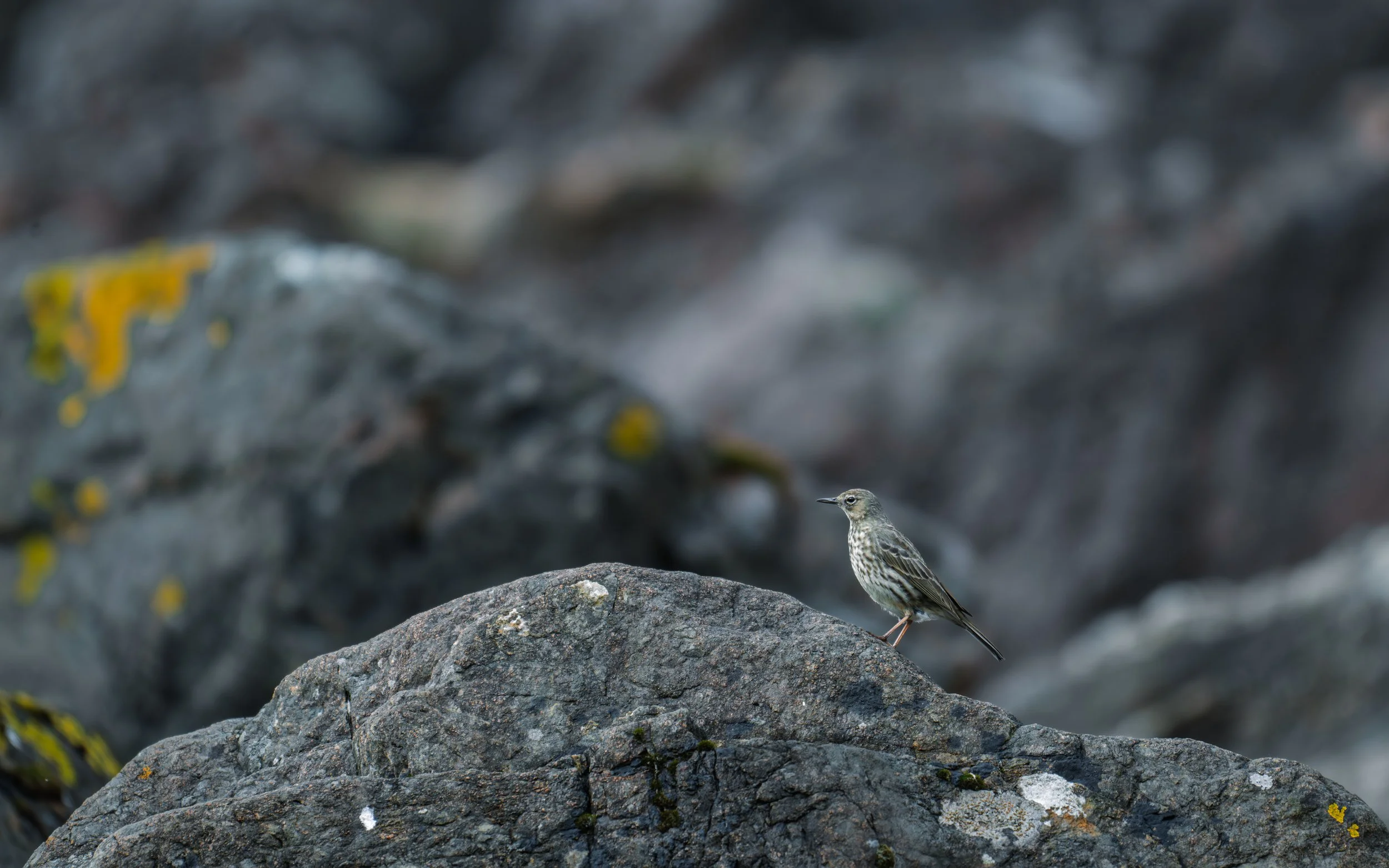
The Birding Detour
Most normal people who arrive in the Highlands after a long day of travelling would probably head straight to their accommodation and relax.
We, on the other hand, decided to drive another 45 minutes around the loch — making it a 90-minute round trip.
We could either look for red squirrels or search for Crested Tits. We had both seen red squirrels before. Neither of us had seen Crested Tits.
So naturally, armed with optimism, Google Maps, and absolutely no guarantees whatsoever, we headed into a pine forest that looked so textbook-perfect for Scottish woodland species that I was already mentally composing the caption.
For context, Crested Tits are one of the UK’s rarest and most specialised woodland birds, found almost exclusively within the ancient Caledonian pine forests of the Scottish Highlands. They don’t occur anywhere else in the UK, which makes them a highly sought-after species for birders and wildlife photographers alike. At the time we didnt quite realise we were most definitely not in the right location, but…
This wasn’t just a “nice to see” situation.
This was a “lifer” situation. For all the non birders - A "lifer" is the very first time a birder sees or definitively identifies a specific species of bird in their lifetime.
And this is where wildlife photography does what it does best: takes your high ambitions, high expectations, and carefully laid plans… and politely ignores them.
Nothing.
No Crested Tits.
No birds at all in fact.
Not even a red squirrel turning up to offer emotional support.
It was, by every measurable standard, a failure. A zero out of ten on trip advisor.
And yet, somehow, I was still perfectly happy.
Now back around the loch and to our accommodation.
Should I Become a Lighthouse Keeper?
This portion of the blog was written months after the actual event, I had to take a break, life got in the way as it often does!
By sheer luck rather than careful planning, our accommodation at Corran Bunkhouse turned out to be directly beside the ferry terminal we needed for the following morning.
As it happened, this was excellent news.
After checking in and chatting with the owner—an absolute gent who immediately made us feel welcome—he offered some simple advice.
“Jump on the ferry as foot passengers, head across the water, and have a pint while the sun goes down.”
Now, I don't know about you, but that sounded like exactly the sort of local knowledge that should be listened to.
For the princely sum of £2, it would have been rude not to. So that's exactly what we did.
A few minutes later we were crossing Loch Linnhe aboard the Corran Ferry, heading towards Ardgour with no particular plan beyond enjoying the evening and seeing where it took us. There was something wonderfully simple about it all. No itinerary. No target species. No pressure to create photographs. Just a ferry crossing, a pint, and a Highland sunset.
We settled into the Ardgour Inn overlooking the loch with a couple of local beers and watched the evening unfold.
This was one of those travel moments that lodges itself in your memory far more deeply than it has any right to.
The light softened. The mountains darkened. The water flattened almost to glass.
And suddenly the scale of the Highlands made itself felt all over again.
Throughout the day I had been impressed by the mountains, the valleys and the scenery, but being out on the water somehow changed the perspective entirely. The landscape felt bigger. Wilder. More remote. It is difficult to describe, but the Highlands seem to operate differently compared to anywhere else I've visited in the UK.
Perhaps that's because this landscape has had a rather dramatic history.
Much of the area was shaped by vast glaciers during the last Ice Age, carving out the lochs and glens that define the Highlands today. Fire, ice and an incomprehensible amount of time have created a landscape that often feels less like Britain and more like somewhere a fantasy novelist invented after several strong coffees.
Eventually, we finished our drinks and wandered down to the shoreline with the long lenses.
Up until this point, the cameras had mostly been pointed at landscapes with the shorter lenses firmly attached.
Now it was time to see what wildlife was about.
The species list wasn't exactly setting any records.
We encountered Hooded Crow, Common Sandpiper, Ringed Plover, Oystercatcher, Cormorant, Siskin, Robin and Mallard.
Objectively, it wasn't a spectacular tally.
Emotionally, it didn't matter in the slightest.
I was having far too much fun.
Besides, I had become completely distracted by a nearby lighthouse.
For a solid ten minutes, I found myself considering whether lighthouse keeper might actually be the ideal career choice.
Think about it.
No traffic. No pointless meetings. No endless emails.
Just seabirds, sea air, dramatic weather and the occasional passing boat.
The more I thought about it, the more sensible it seemed.
As I write this several months later, I am still not entirely convinced it isn't an excellent life plan.
I am certainly not ruling it out. Despite the need for all of my furniture to be round!
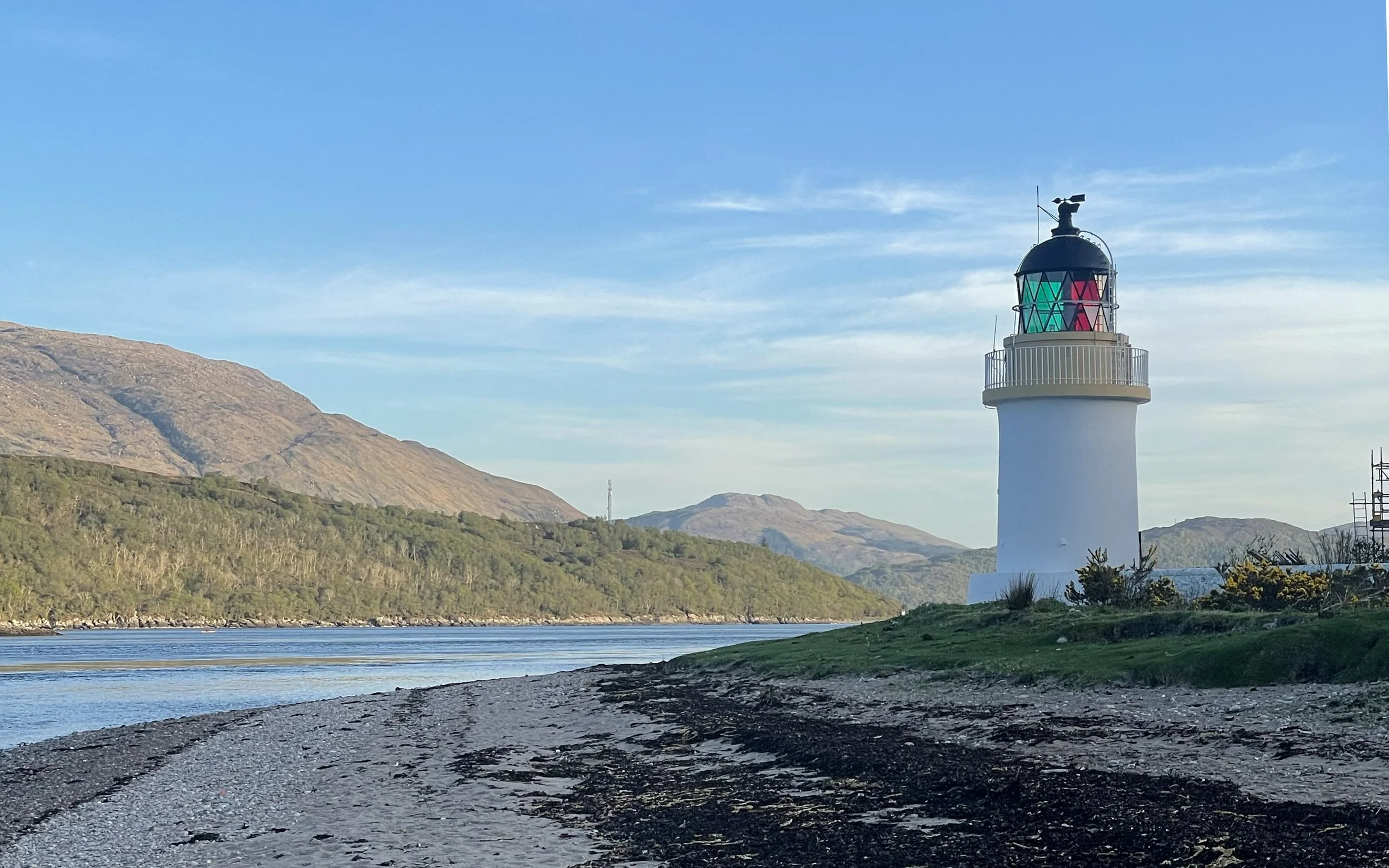
My future home?
Day Two
Sunrise at Loch Linnhe
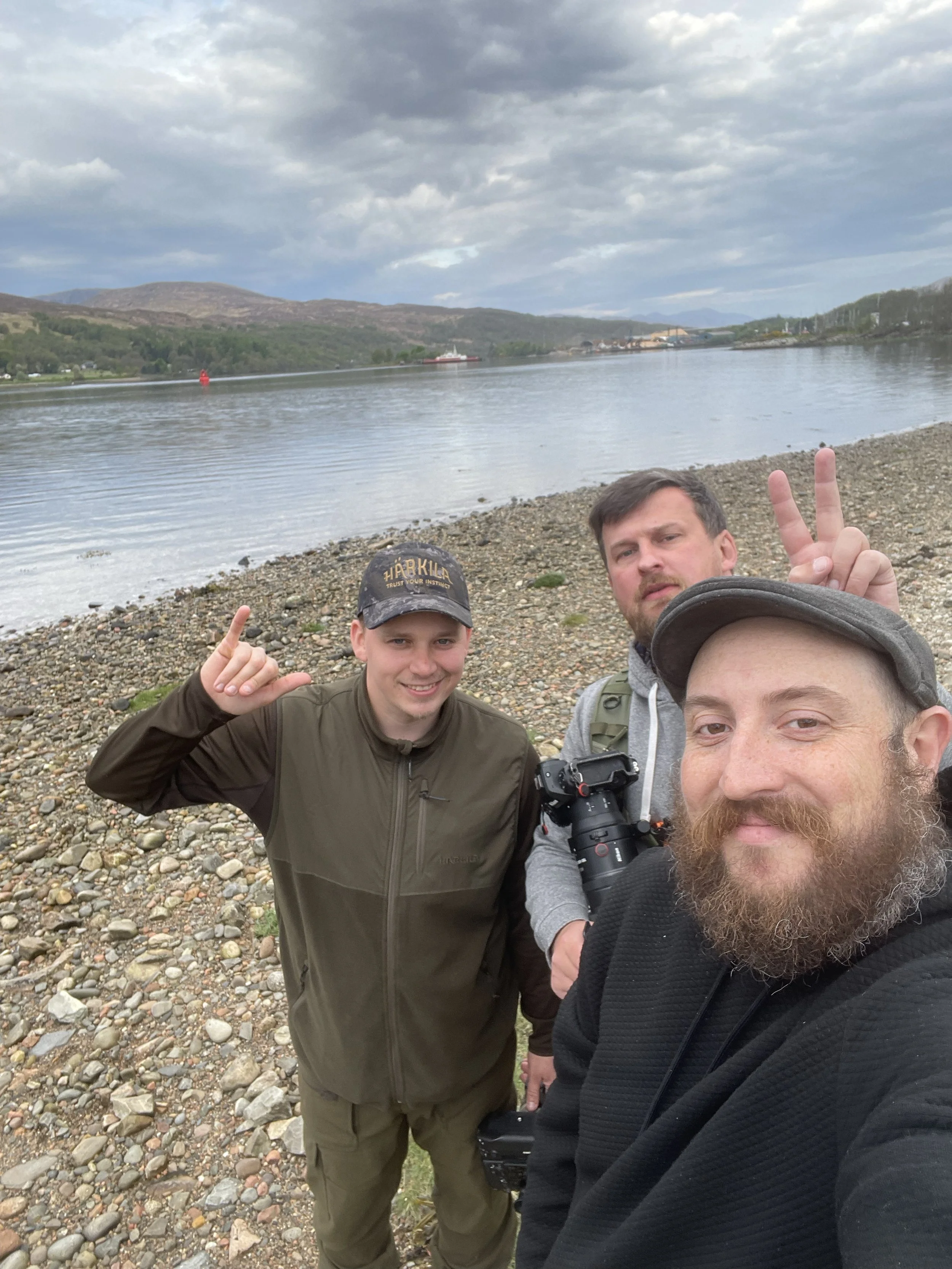
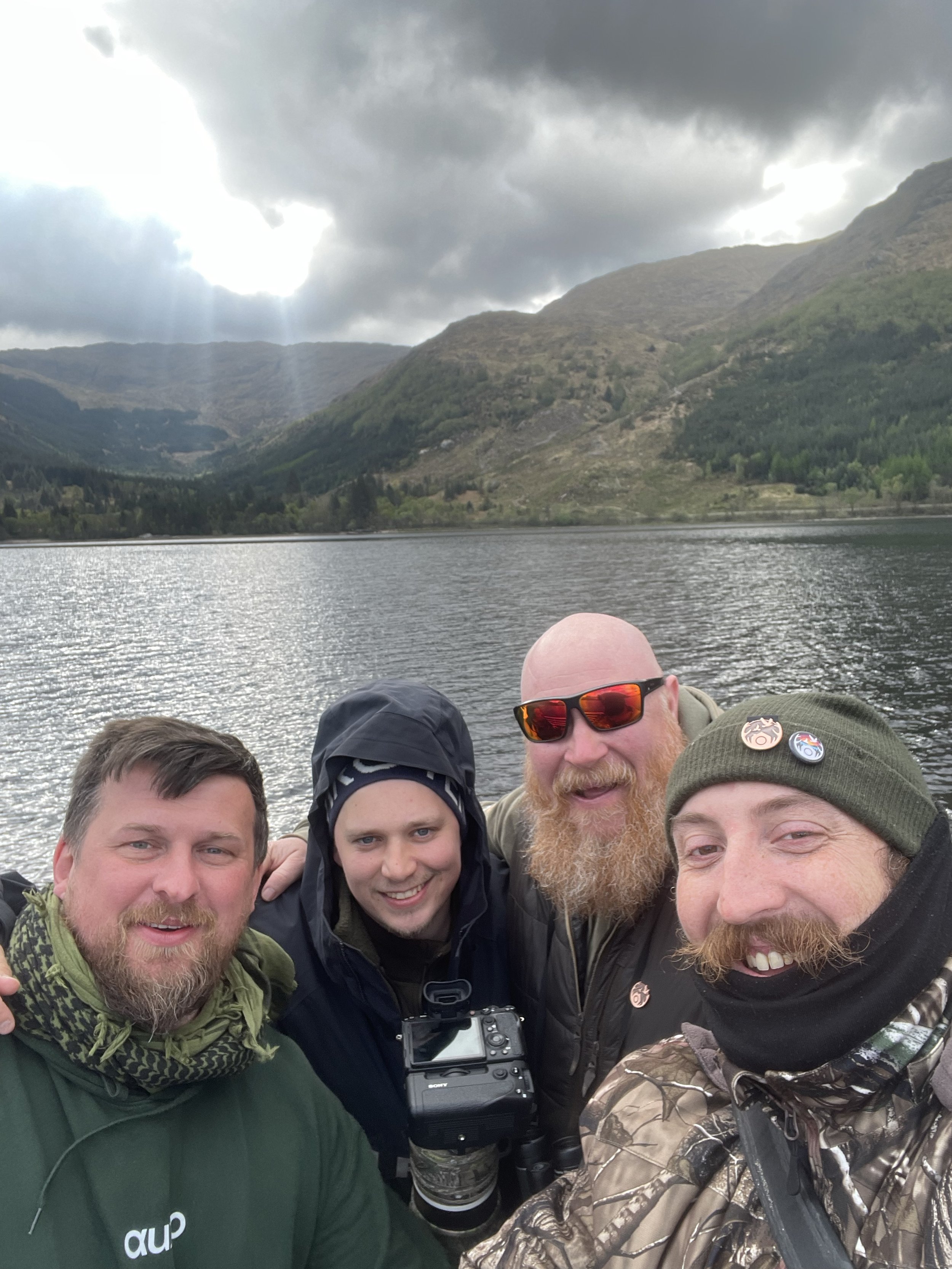
At 5am—while every sensible holidaymaker remained fast asleep—Aaron, Curtis and I were already standing beside Loch Linnhe waiting for sunrise.
This was not one of those mornings where you drag yourself out of bed, stumble into the dark and hope for the best.
This was one of those rare mornings photographers dream about but don't experience nearly often enough.
The water was completely still, layers of mountains faded into the distance.
Soft colour slowly spread across the sky.
Everything seemed perfectly balanced, as though someone had carefully arranged the entire scene before we arrived.
It was one of those moments where compositions almost presented themselves. All you had to do was slow down, take it in, and avoid making any stupid mistakes.
For the sunrise landscapes, I was using:
Camera: Nikon Z9
Lens: Nikon 70–200mm f/2.8
Settings: ISO 64 | f/11 | 1/50 sec
Technique: Four shot panoramic
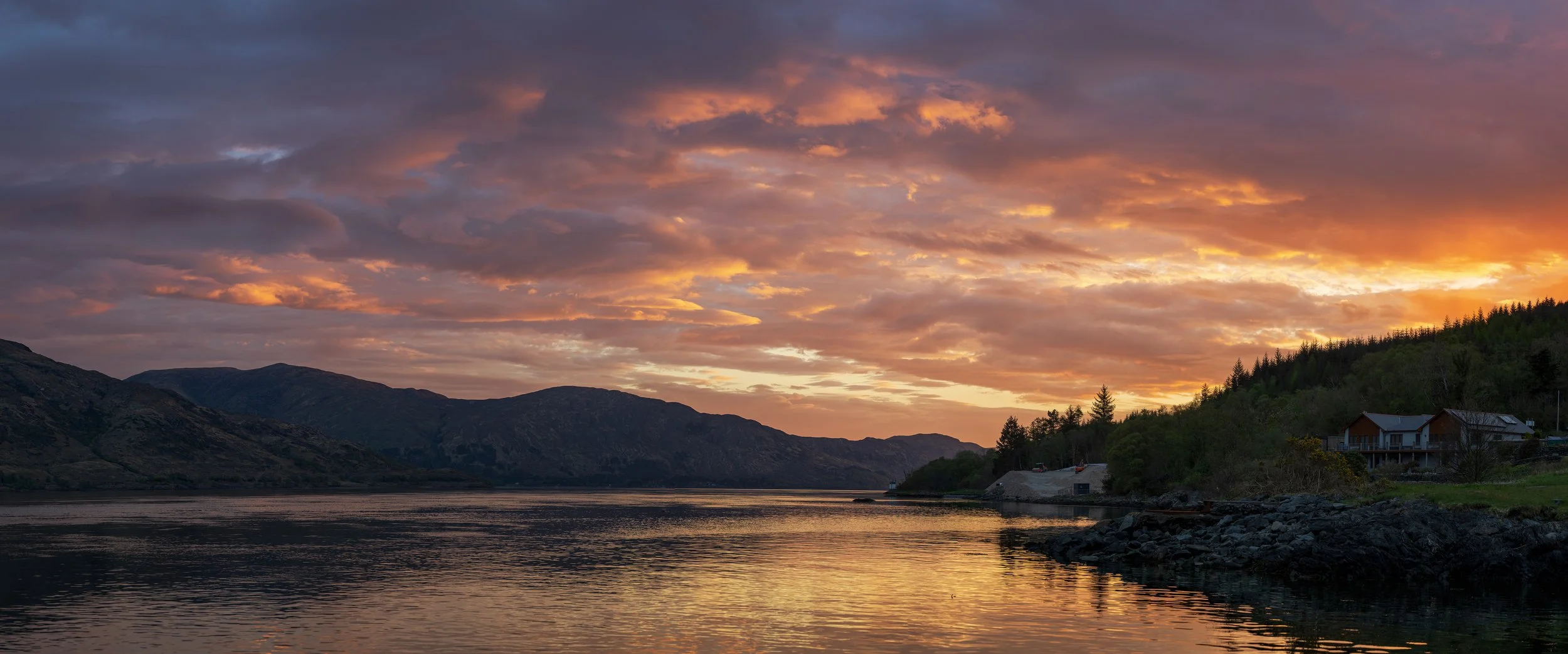
Sunrise from the Corran Ferry Crossing
At one point Curtis looked over the back of my camera and gave the sort of understated photographer approval that means far more than enthusiastic shouting ever could.
"That's a shot."
High praise. I stored that compliment away immediately.
Eventually, hunger got the better of us and we made our way from Corran towards Fort William in search of breakfast.
Now, I may have mentioned this before, and I suspect it won't be the last time it appears in a blog, but my breakfast of choice before a day of wildlife photography remains unchanged.
A McDonald's Double Sausage and Egg McMuffin and a Flat White.
The breakfast of champions (and wildlife photographers).
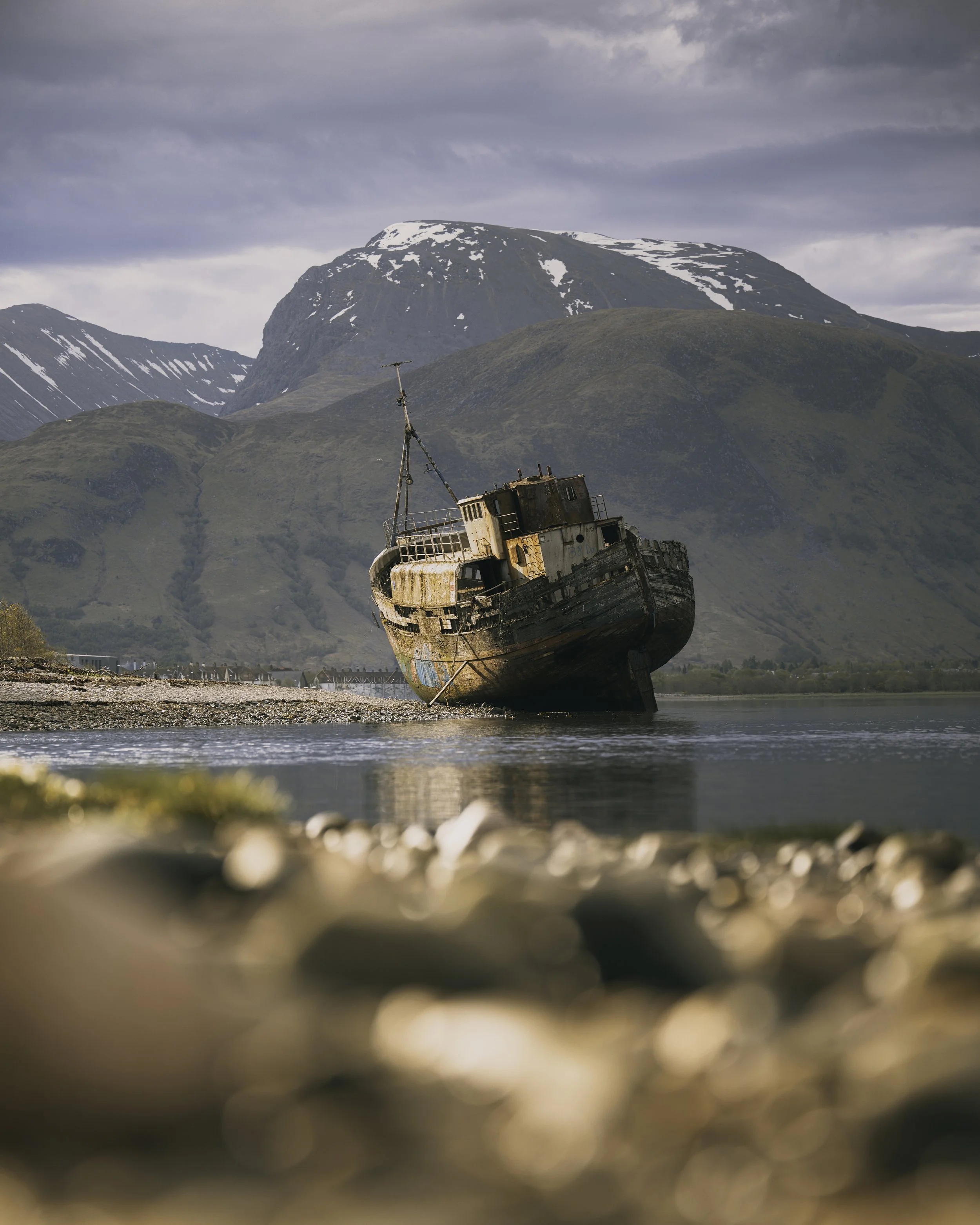
With breakfast secured, we headed towards one of the most photographed locations in the area: the Corpach Shipwreck.
Officially known as the MV Dayspring, the vessel is a former fishing boat that has sat abandoned on the shores of Loch Linnhe for years. Rusting away against the backdrop of Ben Nevis and the surrounding mountains, it has become one of Scotland's most recognisable photographic subjects.
For me, it was a welcome change of pace.
After all, unlike most wildlife subjects, shipwrecks tend not to fly away, disappear behind a bush, or wait until you've looked away before doing something interesting.
The three of us spent a while photographing the wreck, chatting, and generally enjoying ourselves.
In fact, we were enjoying ourselves so much that I eventually put my camera down for a few minutes.
This proved to be a mistake. Curtis immediately picked it up.
At the time, this was Curtis's first experience using a Nikon camera and his first attempt at shooting landscapes with a 70–200mm lens. Naturally, he lined up a composition, pressed the shutter, and produced an image that most photographers would have been delighted with.
To say he was pleased would be an understatement.
What makes the story even better is what happened afterwards.
That image would eventually be published in Digital Camera Magazine.
Not a bad result for someone borrowing another person's camera and lens.
The experience also sparked a slight obsession with telephoto landscapes, eventually leading to Curtis purchasing his own 70–200mm lens.
I maintain that I should probably receive some sort of commission; at the very least a coffee.
My version of the image is below. I should probably just mention me and Curtis are great pals and always celebrate each others achievements no matter who’s camera they were taken on. Check out his photos here - Curtis’ Instagram
Seals, Shorelines and Meeting the Apex Crew
After breakfast, we crossed the ferry again and spent some time wandering the shoreline, photographing a handful of seals before eventually linking up with the rest of the group once they had arrived.
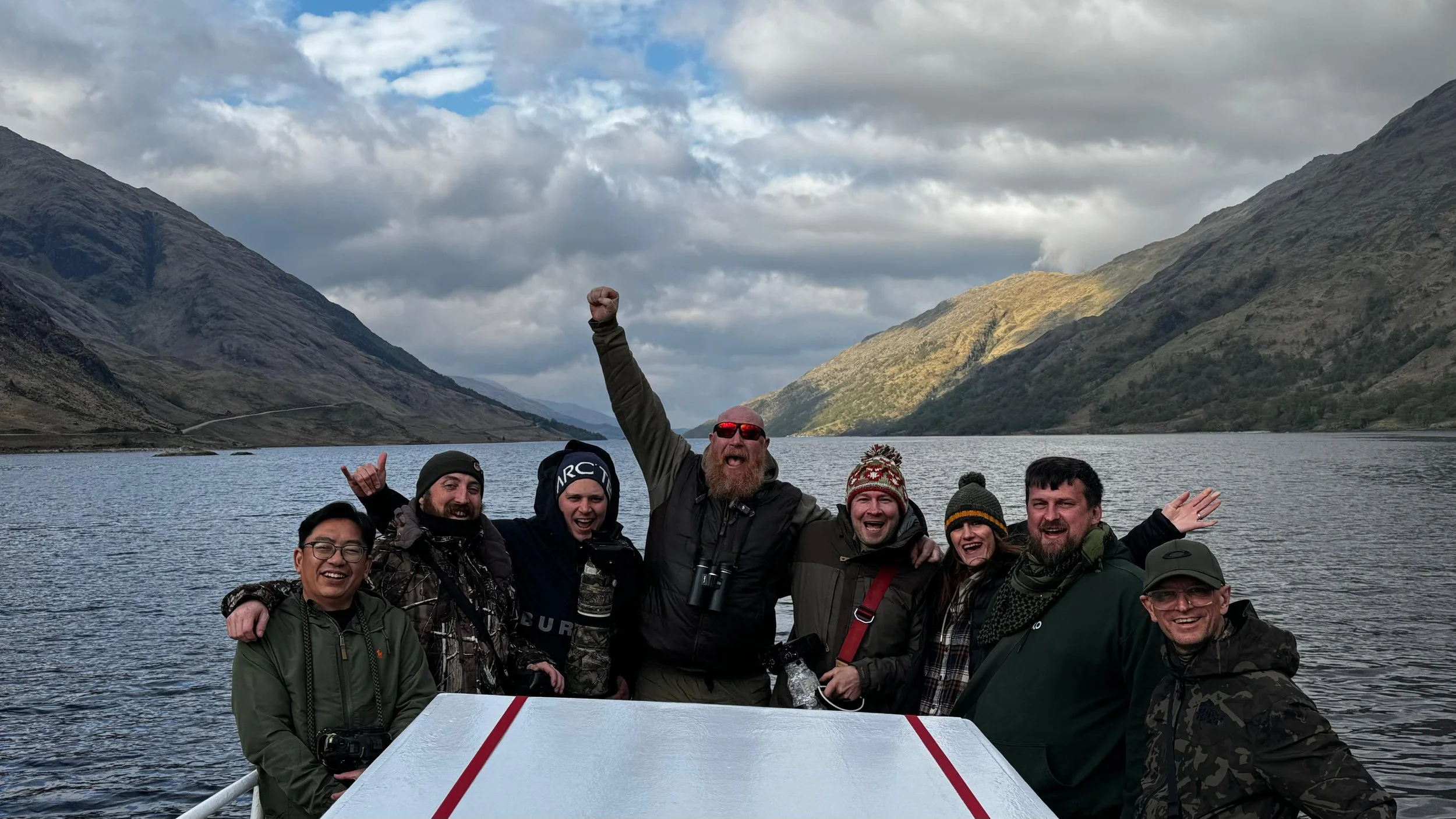
Now it was time to meet the people I'd be sharing the adventure with. Big shout out to everyone involved that I haven’t mentioned already:
Emily Taylor - https://www.instagram.com/emilyjtaylorphotography/
Daren Cole - https://www.instagram.com/daren_cole_photography/
Martyn Harris - https://www.instagram.com/mmartynharris.co.uk/
Steven Lui - https://www.instagram.com/stevenlui0826/
There was no awkwardness, no forced introductions and none of that slightly uncomfortable “so, what do you photograph?” small talk. We already had the perfect common ground. Cameras came out, wildlife conversations started and, before long, we were laughing like we'd known each other for years.
That was one of the things I really enjoyed about the trip. Everyone was there for the same reason. We were all slightly obsessed with wildlife, photography and being outside, so conversation never needed forcing. One minute we were discussing what we'd seen, the next we were taking the piss out of each other.
The atmosphere felt natural from the start.
It felt less like joining a guided tour and more like travelling with a group of friends who just happened to know where all the good wildlife was.
I'd met Mike before this trip, so I already knew what to expect. If you've spent any time around wildlife photographers, there's a good chance you'll have heard his name mentioned at some point. Despite being one of the most respected wildlife photographers I know, he's also one of the most approachable, generous and genuinely funny people you'll meet.
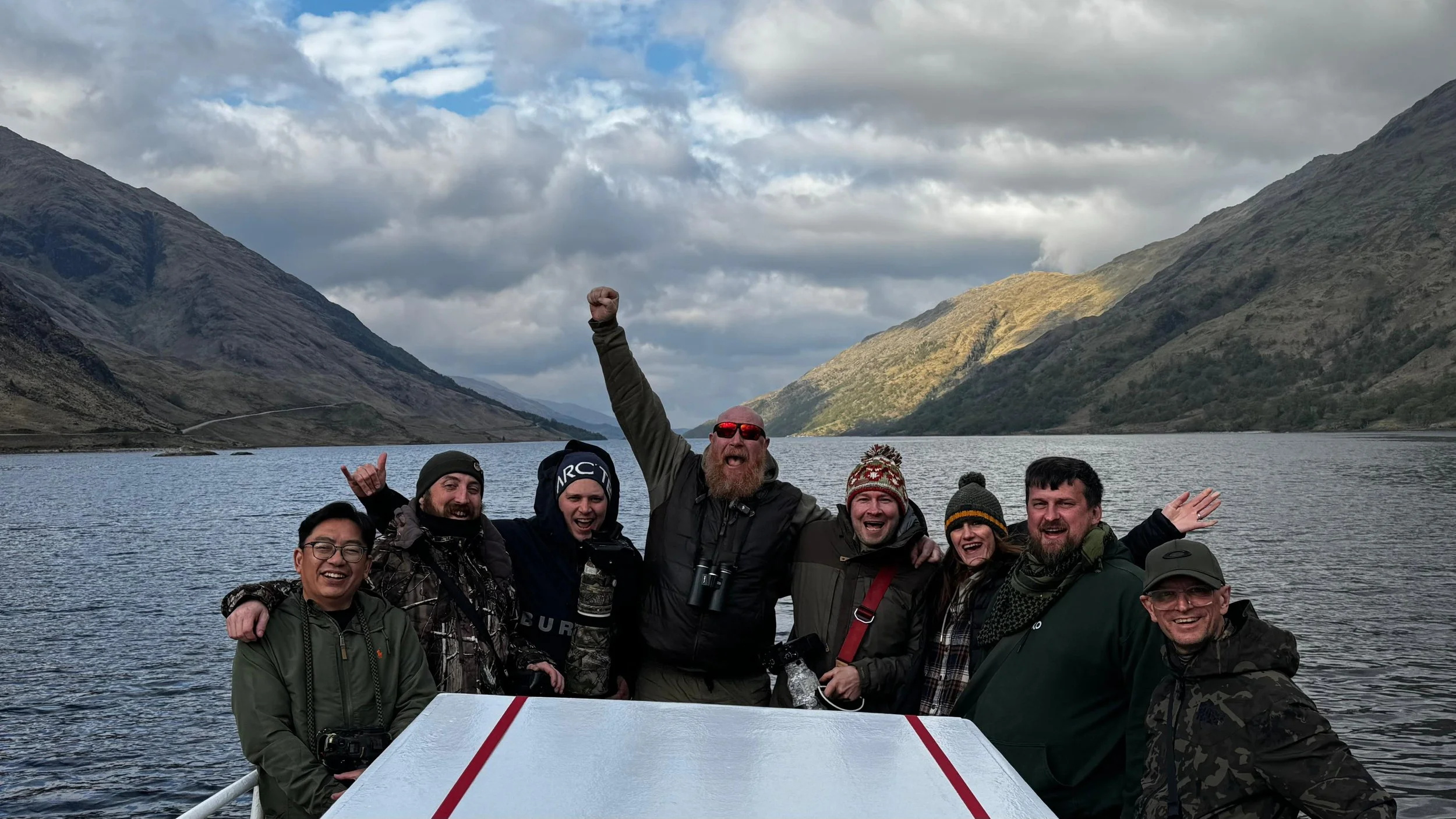
What a team!
The Great Northern Diver!
Later that afternoon, we found ourselves on the shores of Loch Linnhe photographing a Great Northern Diver.
Or, as I confidently called it at the time, a Loon.
Now, before I explain how this went spectacularly wrong, let me set the scene.
We were all sat along the shoreline, looking out across the loch, when I heard a call.
It was one I recognised immediately.
I'd heard it countless times before in TV shows and films, but never in real life. My brain started frantically scanning its internal database of bird calls, and then the penny dropped.
A Loon.
I was bloody excited.
I turned my attention towards the water and started searching for the source of the call.
And then—boom.
About 100 feet offshore, there it was, diving repeatedly.
I turned to Mike with what I thought was the confidence of someone who had just correctly identified a bird by its call.
"Mike, there's a Loon out there."
There was a pause.
Then came an incredibly long discussion and much laughter.
What followed can only really be described as a sustained period of friendly piss-taking at my expense.
You see, there was just one small problem.
Great Northern Divers and Loons are the same bird.
They're called Great Northern Divers here in the UK and Loons in North America.
I hadn't actually misidentified the bird at all.
I'd simply used the wrong geographical terminology with an audience who were never going to let me forget it.
Unfortunately, Mike found this absolutely fucking hilarious.
And so did everyone else.
The joke continued throughout the trip, long after we'd left Loch Linnhe, and eventually became so firmly established that it was immortalised in the YouTube video linked below.
I still maintain that I was technically correct even if nobody else agrees.
Regardless of what we called it, the bird itself was beautiful. It was also an absolute menace.
It spent most of its time diving underwater, appearing somewhere completely different, disappearing again, and generally doing everything possible to make getting a decent photograph incredibly difficult.
I never really managed to get a usable photograph of it, but honestly, I didn't care.
I'd heard that call countless times through a speaker. Now I'd heard it in the wild.
That was enough.
It was my first proper encounter with a Great Northern Diver, another lifer for the trip, and one that I certainly won't forget.
Although, thanks to Mike and the rest of the group, I'm fairly confident I'll never misidentify a great northern diver again!
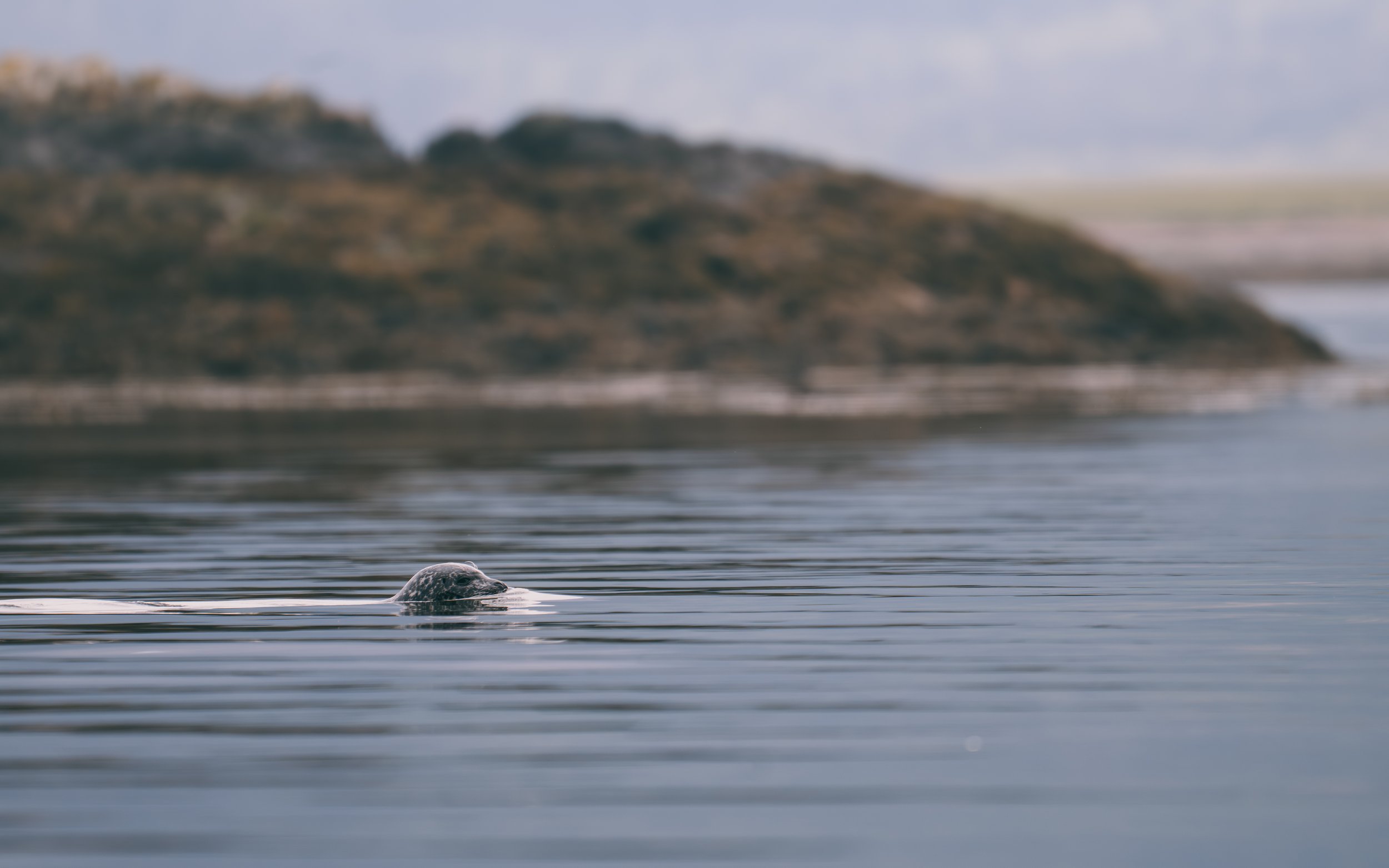
Here’s a seal because I couldn’t get a photo of the LOON!
Evening Light & Pizza
After a short break from photography, we headed back to the house Apex Adventures had rented for the whole group for the weekend.
But the day wasn't over yet.
We drove back down to the pub Aaron and I had visited the previous evening for another pint and a walk along the beach. The evening light was beginning to soften, and once again the Highlands seemed determined to give us something else to photograph.
This time, it was a pair of Common Eider.
They drifted quietly across the water as the light faded, producing one of the strangest and most endearing bird calls I have ever heard. Somewhere between a soft, ghostly coo and an old bicycle horn.
At this point, I'd started wondering just how many new species I could possibly rack up on a single trip.
Naturally, the cameras came out again.
More excited shutter pressing followed, because apparently we'd all forgotten that we'd been photographing wildlife for most of the day already.
Eventually, though, the light disappeared and hunger took over.
By the time we headed back to the house, local cider had been acquired, pizzas had been cooked, and the whole place had filled with that brilliant combination of exhaustion and adrenaline that only follows a very good wildlife day.
Memory cards were dumped and photos were being reviewed.
Editing decisions were discussed. Curtis and I spoke for a long time on editing techniques with varying outcomes after trying them…
Opinions were offered but importantly nobody stopped chatting and laughing.
It had been an incredibly long day, but somehow it didn't feel like one. We'd watched the sunrise over Loch Linnhe, photographed a shipwreck, explored the shoreline, met the rest of the group, found seals, added multiple lifers to the list and generally spent the day doing exactly what we'd come to Scotland to do.
And yet, despite everything we'd already experienced, there was still one thing hanging over the group.
Tomorrow was eagle day.
The reason many of us had travelled all this way.
The bird I'd dreamed of seeing for years.
The anticipation was now fully built.
Sleep was necessary.
Unfortunately, excitement doesn't always understand the concept of sleep.
Still, the alarms were set, batteries were charging, cameras were ready, and another early start was waiting for us in the morning.
Tomorrow, we would finally go looking for White-tailed Eagles.
Day Three
Eagle Day
This was it.
Everything we'd done so far had been building towards this morning.
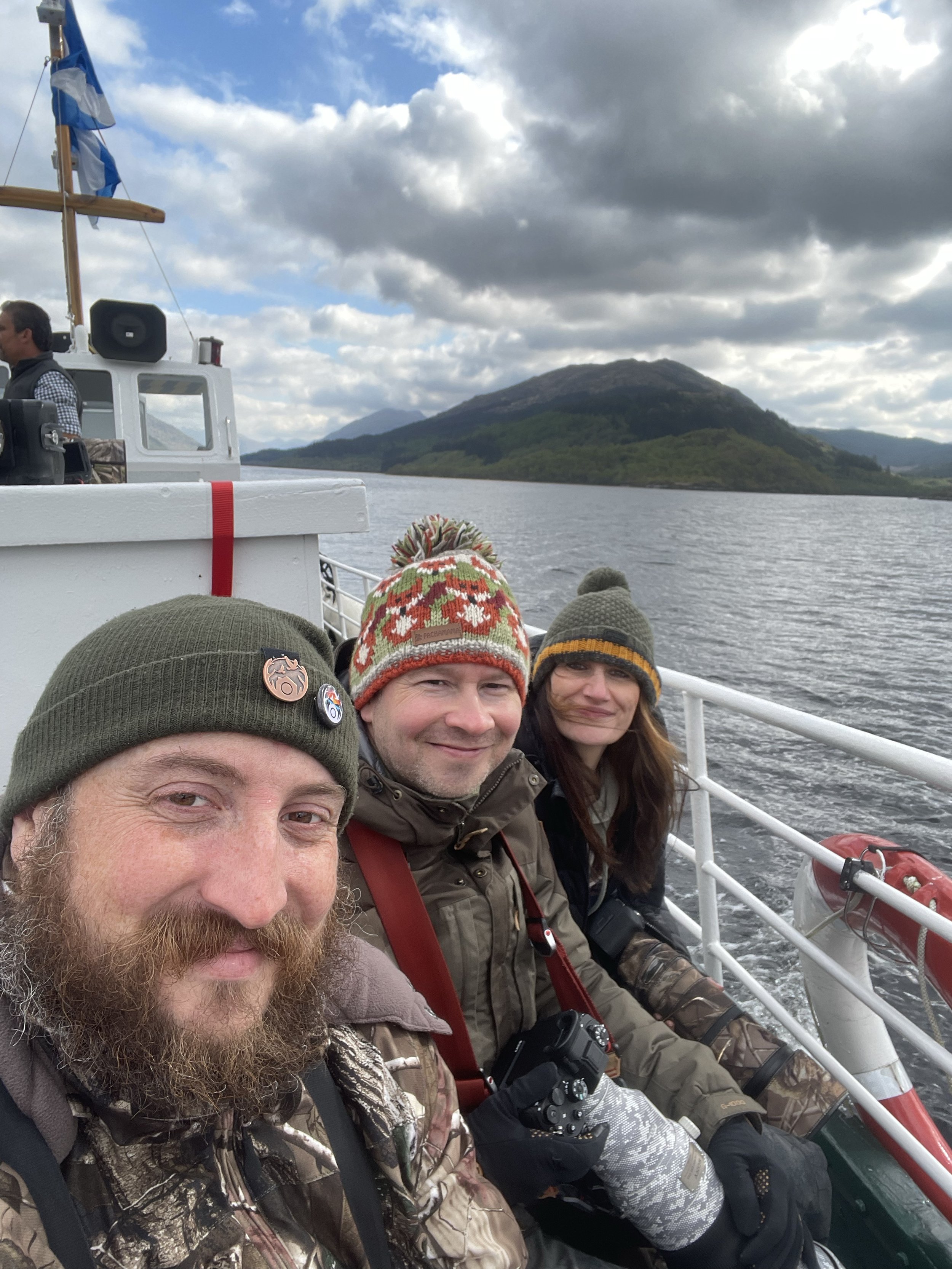
We headed out early, following the roads north through magnificent woodland and along the shores of yet more lochs. After around an hour on the road, we arrived at the shores of Loch Shiel, where we met Ali and the crew from Loch Shiel Cruises.
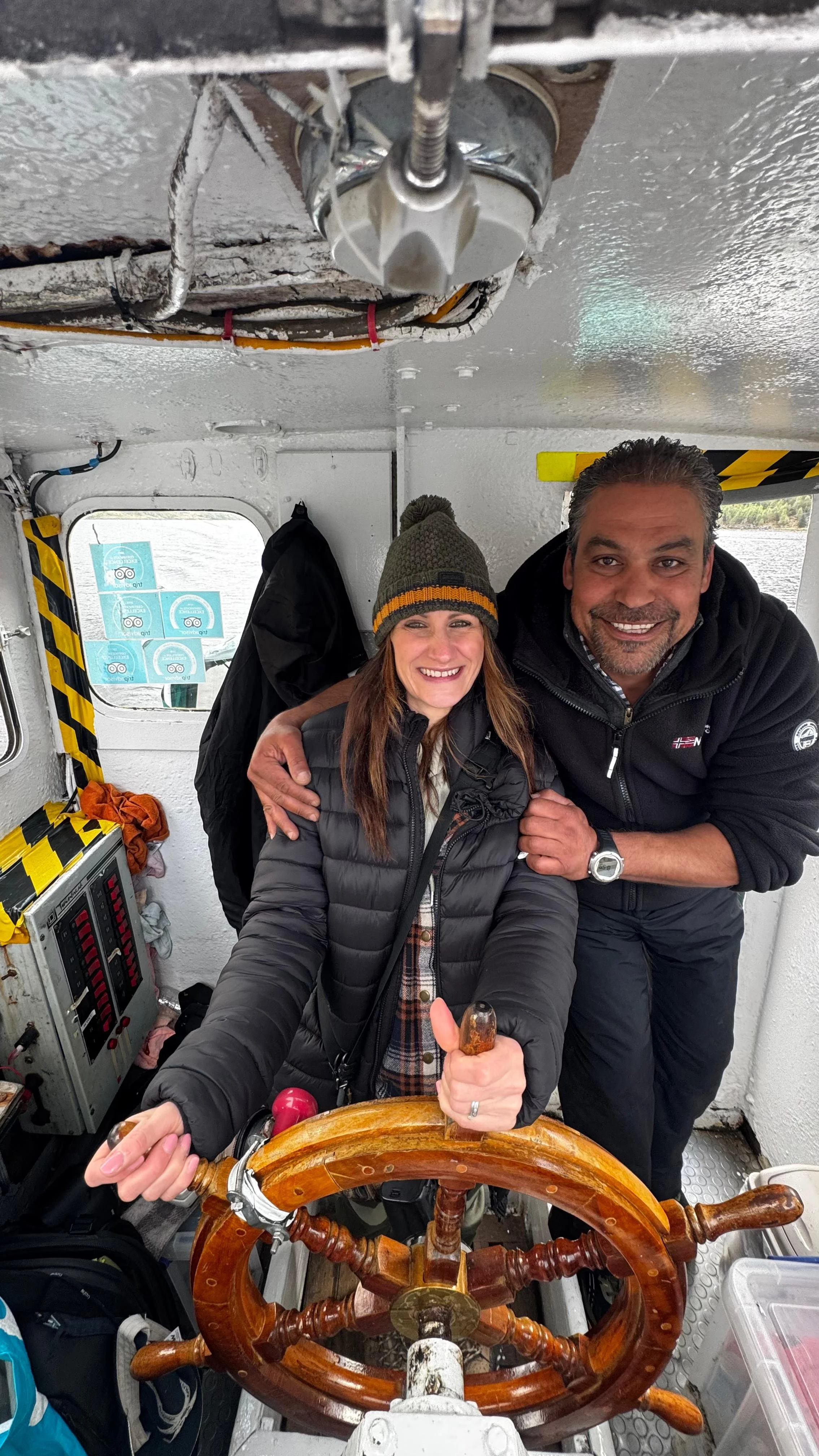
Waiting for us was the M.V. Sileas. At first glance, it looked as though it had been sitting on the loch since the Highlands were invented.
Built in 1940 by James A. Silver Ltd. at Rosneath, the 52-foot Sileas was originally constructed as an Admiralty pinnace for the Royal Navy. Built from teak on oak frames, she was designed to transport cargo and crew between harbours and larger warships. After a career with the Admiralty, she eventually found her way to Loch Shiel, where passenger cruises began in 1998.
At around 86 years old, she somehow felt perfectly suited to the landscape.
Weathered. Dependable. Full of stories.
Ali talked us through the boat, the history of the loch and the plan for the day before we headed out onto the water.
This wasn't a normal tourist cruise either.
The entire boat had been exclusively rented for the Apex group, meaning there were no members of the public on board. For a group of wildlife photographers, that made a huge difference. We could move around, change positions, talk through compositions and, most importantly, react quickly when wildlife appeared without having to worry about getting in anyone else's way.
The loch itself is enormous. At around 28 kilometres long, it is Scotland's fourth-longest loch and reaches depths of approximately 128 metres. It was carved by glaciers and remains remarkably wild, with much of the surrounding landscape feeling almost completely untouched.
But there was something else about the water that immediately caught my attention.
It looked almost black.
Ali explained that the dark appearance is largely caused by the surrounding peatland. Organic material from peat-rich ground enters the water, giving it a dark, tea-coloured appearance.
Against the mountains, it looked incredible.
The surface was almost like a giant sheet of black glass, reflecting the surrounding landscape as we slowly made our way further into the wilderness.
For the first hour or so, we simply chugged up the loch.
There was plenty of chatter, plenty of anticipation, and an almost ridiculous amount of staring into the distance.
Every few minutes someone would point something out.
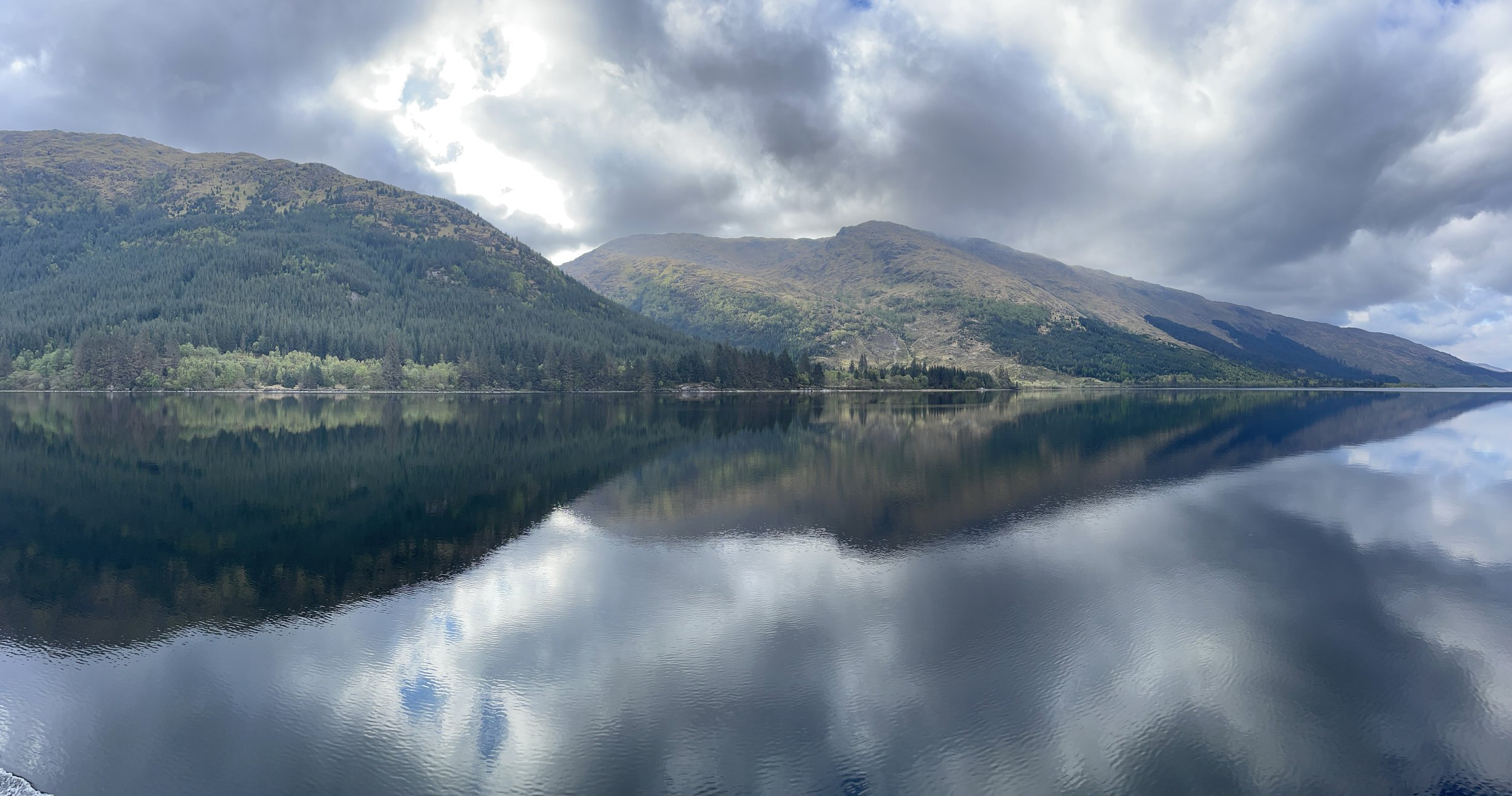
Loch Shiel looking as smooth as glass
Then it happened. The first White-tailed Eagle was spotted.
Britain's largest bird of prey had quietly appeared in the landscape.
Everything stopped and the conversations fell silent.
Our cameras came up.
After all the build-up, all the planning, all the travelling and all the anticipation, there it was.
A White-tailed Eagle right in front of us.
I was genuinely struggling to process what I was seeing.
The first bird we found was perched high above us and, unfortunately for a boat full of photographers, had absolutely no intention of moving.
So we watched it for a while before deciding to leave it alone and continue searching.
And this is where I still can't quite believe I'm writing this sentence.
We went looking for more eagles. More… As though finding one of Britain's largest birds of prey wasn't already enough.
It wasn't too long before we found another.
A male named Fred was perched majestically, looking out across the loch.
We kept our distance and watched him for around ten minutes. Fred looked completely relaxed.
Then, without warning, he launched himself from the tree, straight down towards the water.
Now, White-tailed Eagles are impressive when they're sitting in a tree.
But when one takes flight, you suddenly understand just how big these birds really are. They're bloody enormous.
And when they fly close to a boat you're standing on, there really aren't words to describe it.
Watching Fred skim across that dark water, his feet extended, wings stretched wide against the mountains behind him, was one of the most thrilling wildlife spectacles I have ever experienced.
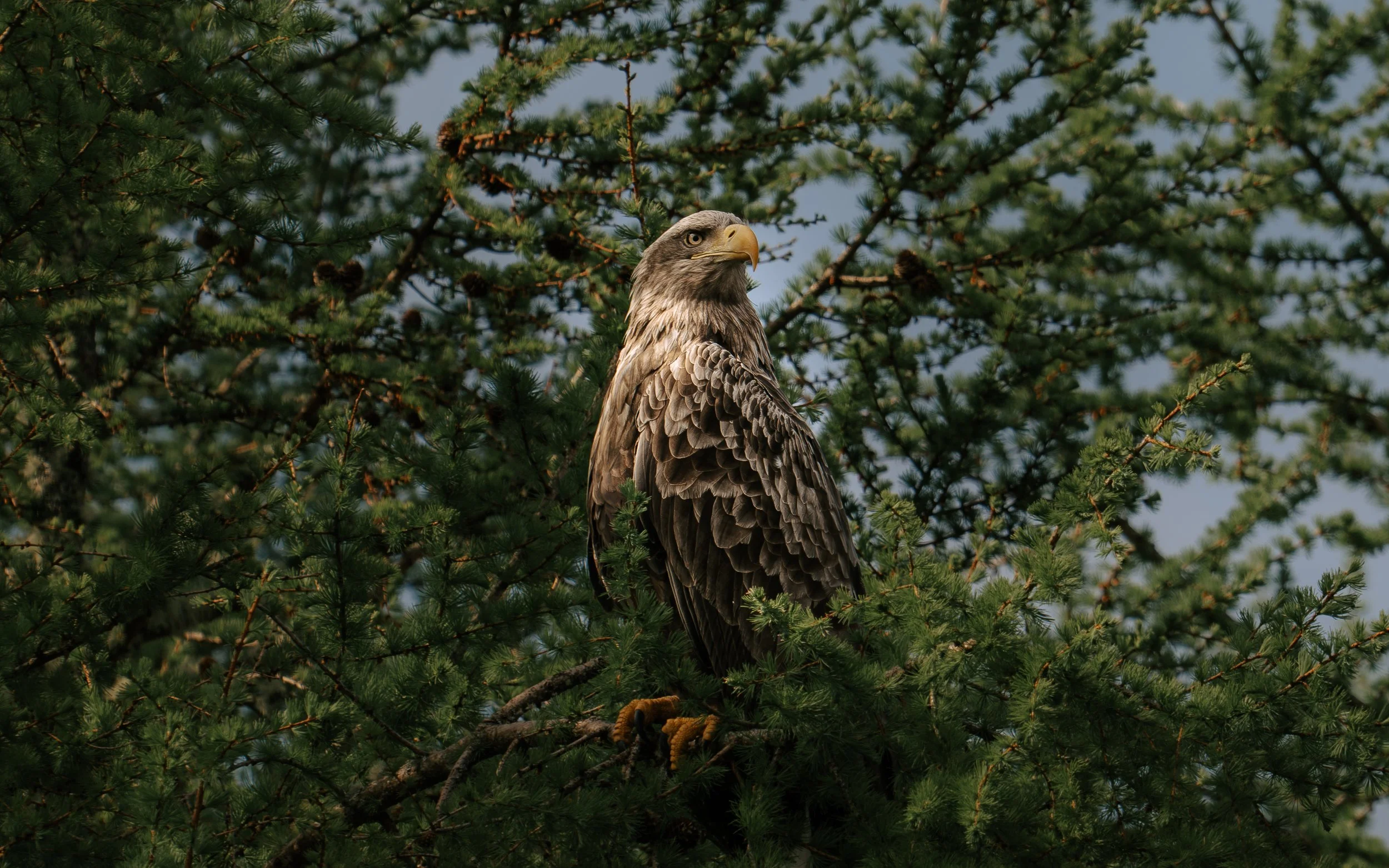
Fred - White Tailed Eagle
The boat erupted. Everyone was talking at once.
There was that strange mixture of disbelief and excitement that happens when something you've dreamed about actually happens right in front of you.
This was why we'd come to Scotland and it was everything I'd hoped it would be.
We spent the rest of the day travelling up and down the full length of Loch Shiel, with Ali and his crew making us feel incredibly welcome throughout.
There was wildlife everywhere.
Birds moving across the water, Red Deer on the hillsides, Black-throated Divers.
And, of course, endless opportunities to simply sit back and take in the landscape.
At lunchtime we stopped and finally had the chance to stretch our legs.
A short walk took us to a local shop where we picked up what can only be described as a traditional Scottish wildlife-photographer's lunch.
Meat pies and Irn-Bru; it was fucking glorious.
After lunch, we climbed back aboard the boat and began the journey back towards our starting point.
By now, the initial excitement had settled slightly, but nobody was exactly quiet.
We had seen White-tailed Eagles. Up close and in the wild.
And we were all trying to process what we'd just experienced while simultaneously checking cameras to make sure we'd actually managed to photograph it.
Ali was fantastic throughout the day.
His knowledge of the loch and its wildlife was obvious, but what really stood out to me was his understanding of photography. As a wildlife photographer himself, he knew exactly how to position the boat to give everyone the best possible opportunity without unnecessarily disturbing the birds.
He wasn't simply taking us to see the eagles, he understood why we were there which made a huge difference.
If you ever get the opportunity to visit Loch Shiel, I genuinely cannot recommend heading out with Ali and the team highly enough. Loch Shiel Cruises specialises in exploring this remote stretch of the Highlands, with opportunities to see White-tailed Eagles, Golden Eagles, divers, Red Deer and plenty of other wildlife along the way.
And somehow, even after everything we'd seen that day, the Highlands still had room for another layer of cinematic absurdity.
Ali explained the landscape surrounding Loch Shiel has appeared on the big screen, including in Harry Potter and Highlander.
Standing there, surrounded by enormous mountains, dark water and one of Britain's most spectacular birds of prey, I could completely understand why filmmakers had come here.
This place doesn't need special effects, it already looks unreal.
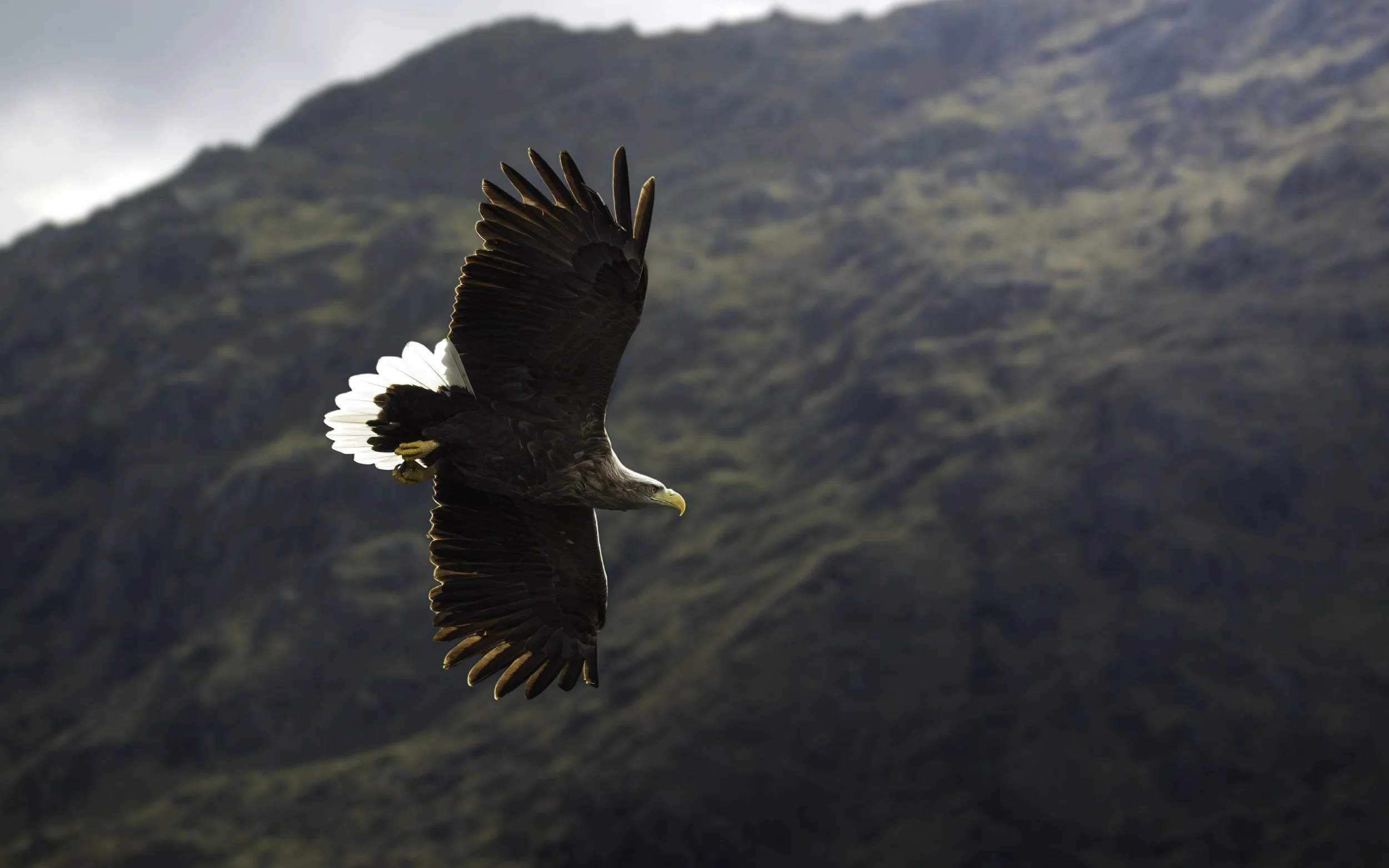
Fred taking to the skies
Back at the House
That evening we returned to the house exhausted, happy and still buzzing from everything we'd witnessed out on Loch Shiel.
Chilli con carne was served, pints of Thistly Cross cider appeared, and before long laptops were glowing with freshly imported eagle photographs as everyone relived the highlights of the day.
As always seems to happen on trips like this, the conversation drifted far beyond photography. We talked about editing, wildlife, work, future plans and life in general, with the discussion bouncing effortlessly between absolute bollocks and surprisingly meaningful topics.
There was no rush, no emails, no deadlines and nowhere else anyone needed to be.
Just a group of like-minded people reflecting on an unforgettable day in the Highlands.
The eagles may have been the reason we came to Scotland, but by the end of that evening we were all leaving with much more.
Day Four
The Final Morning
The final day began as the others had: early, cold, and entirely worth it.
One last wander down to the beach. One last coffee beside the loch. One last look at the mountains before packing the bags and beginning the journey home.
There is something particularly cruel about the final morning of a trip. You're tired, slightly battered from carrying camera gear around for days, and yet the idea of staying another week feels completely reasonable.
Leaving felt wrong.
Thankfully, the journey home wasn't over just yet. Aaron still had to get me back to Glasgow Airport, which gave us time for one final stop at the Wee White House.
Officially known as Lagangarbh Hut, the little white cottage sits beneath Buachaille Etive Mòr and has become one of the most photographed locations in Glencoe. We'd passed it earlier in the trip, but this time the conditions were far more atmospheric, so naturally the cameras came back out.
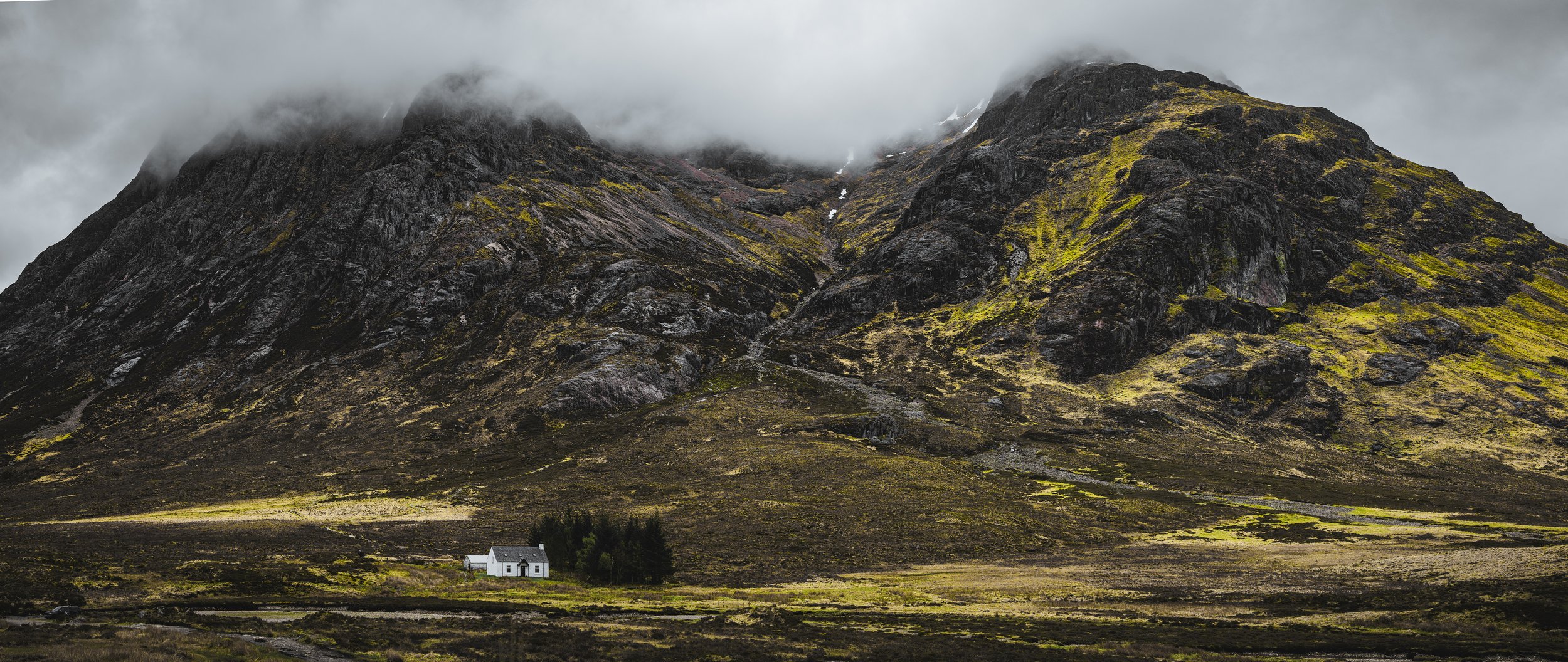
It felt like the perfect place to end the adventure.
The first time we'd driven through Glencoe, I was too busy trying to process the scale of everything around me. This time I had the chance to slow down, take it all in, and capture a few final landscape images before reluctantly getting back in the car.
From there, the Highlands slowly disappeared in the rear-view mirror. The mountains became smaller, the lochs became fewer, and before long we were back among traffic, road signs and reminders that normal life was waiting.
Somewhere on that drive back to Glasgow it finally sank in.
The trip was over.
Four days of incredible landscapes, brilliant wildlife, far too much laughter, several lifers, questionable bridge rankings and more White-tailed Eagles than I ever expected to see.
And honestly? I can’t wait to get back.
Final Thoughts
Over four days, a group of relative strangers became friends through shared experiences, early starts, terrible jokes, long drives, wildlife encounters and late-night conversations around laptops glowing with freshly edited photographs. Somewhere between the ferry crossings, the eagle encounters, the pints, the pizzas and the endless discussions about photography, the trip became about far more than simply adding species to a list.
That's what impressed me most about the Apex Adventures experience.
Of course the wildlife was incredible, the locations were spectacular and everything was exceptionally well organised, but the real success of the trip was creating an environment where like-minded people could come together, share an adventure and leave with memories that will last far longer than any photograph.
I arrived in Scotland hoping to see White-tailed Eagles.
I left with thousands of photographs, a ridiculous number of stories, several new friendships and memories that I'll still be talking about years from now.
The Highlands themselves certainly played their part. There is something about that landscape that forces you to slow down, look around and appreciate where you are. The endless lochs, towering mountains and feeling of genuine wilderness create the perfect backdrop for adventure, and somewhere along the way they reminded me of something I'd probably forgotten.
Life is supposed to feel exciting.
For four days, it absolutely did.
Sometimes you don't need to have everything figured out. Sometimes you just need to say yes, book the flight, pack the camera and see what happens.
Doing exactly that gave me one of the most enjoyable wildlife photography trips I've ever experienced, and I already know it won't be my last visit to the Highlands.
They have a habit of getting under your skin for which I am very grateful.
Want Your Own Apex Adventure?
If you've made it this far, firstly, thank you.
This was a long one.
If you're interested in experiencing the Scottish Highlands or other epic worldwide locations for yourself, photographing incredible wildlife, exploring spectacular landscapes and spending time with a brilliant group of like-minded people, you can find out more about Apex Adventures and their upcoming trips here:
https://www.apex-adventures.co.uk
I genuinely can't recommend heading out with Mike or Adam enough.
Just be prepared for early mornings, cheeks aching from laughter and an insatiable appetite to book another trip.
You've been warned.